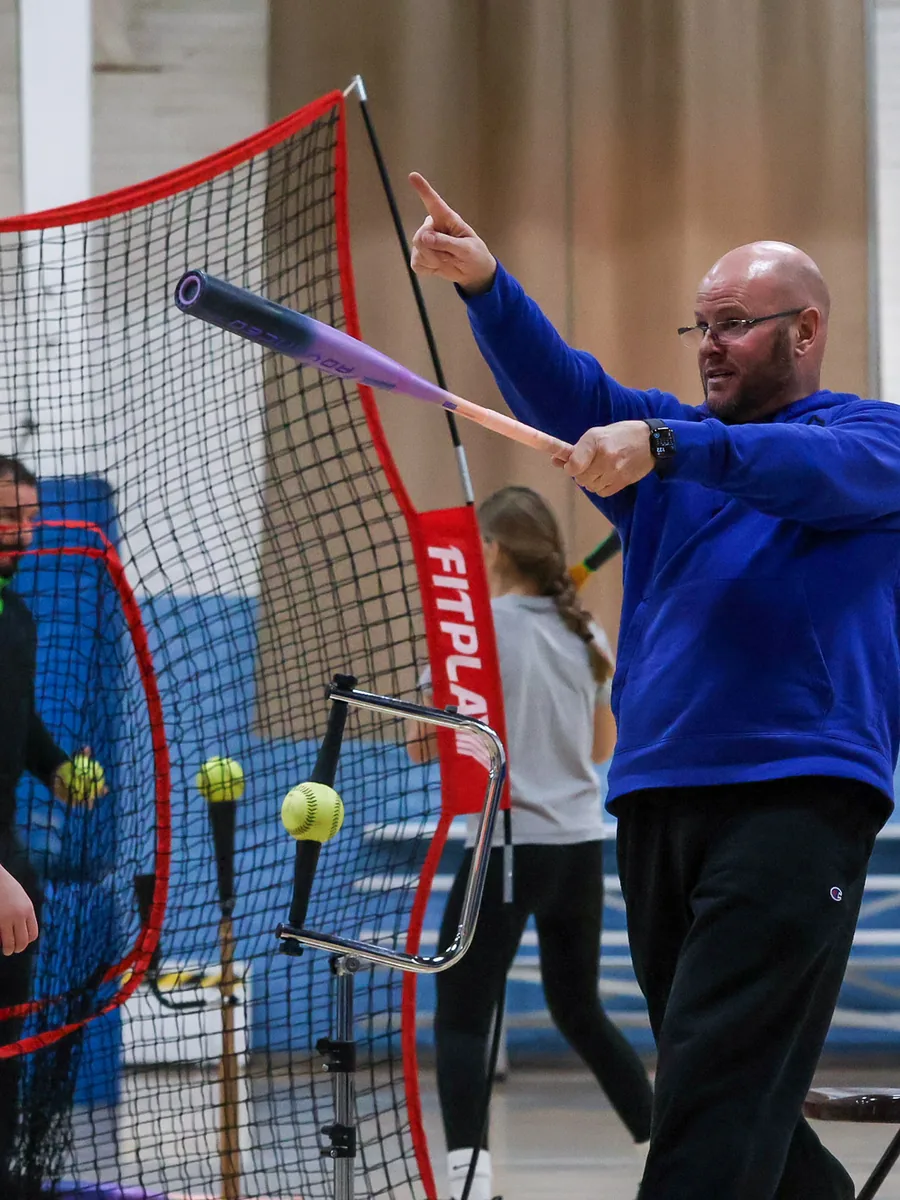
Kevin Staggs
Founder
Kevin started playing baseball at eight and continued through high school before moving into competitive men's travel softball, which took him across North America over fifteen years playing for Worth and TPS. He began coaching as his own kids came up, first in softball and baseball, then three years of high school basketball and the last four years coaching high school softball. He also runs a competitive travel softball team, so he sees firsthand what young athletes carry through a season. He built Staggs Performance Lab to be the training environment he wanted for his own athletes: organized, professional, and built on a plan rather than an hour of drills.
Certifications
- Pauly Girl Fastpitch Pitching Certification
- Foster Fastpitch Pitching Certification
- NASM Certified Personal Trainer (CPT)
- NASM Performance Enhancement Specialist (PES)
Playing and coaching
- 15 years playing for Worth and TPS
- Competitive men's travel softball across North America
- 4 years coaching high school softball
- 3 years coaching high school basketball
- Coaches a competitive travel softball team
Why I built Staggs Performance Lab
I wanted the kind of training environment I would want for my own athletes. Organized, professional, competitive, positive, and centered on actual development. I want parents to know there is a plan behind their athlete's training. I want athletes walking in excited to train and confident they are getting better.
The goal is not to get an athlete ready for their next game. It is to help them get ready for the next level of who they can become.
Kevin Staggs, Founder
What sets us apart from other training facilities.
Purpose
There is a difference between practicing and developing.
Hundreds of repetitions do not automatically make an athlete better. The repetitions need a purpose. Every drill has an objective, every session has a plan, and athletes should leave knowing what they worked on and why.
Confidence
Confidence is part of the work.
Development is not purely physical. How an athlete responds to failure, whether they can make an adjustment, and whether they believe they belong all matter. We want athletes to understand why they are doing something instead of following instructions, and eventually to own their own development.
The whole athlete
You cannot separate the skill from the body.
A powerful swing takes more than swing mechanics. Velocity takes more than a strong arm. Speed, mobility, coordination, balance, rotational power, and body control are all part of it, which is why the skill work and the performance work happen in the same building.
Small groups
Small groups, on purpose.
We would rather coach fewer athletes well than overcrowd a session. That means more feedback, better organization, and coaches who know what each athlete is working on. When a session fills, it closes.
Performance without ignoring the athlete's health
Throwing harder and hitting harder matter, but not at the cost of how an athlete moves and recovers. Young athletes are still growing, and softball and baseball put repeated demands on the shoulder, elbow, trunk, hips, and lower body. Arm care and workload management are built into the program, not bolted on after.
Movement preparation
Nobody walks in cold and throws at maximum effort. Sessions start with age-appropriate mobility, activation, and progressive throwing built around that day's work.
Arm care
Band work, scapular stability, controlled strengthening, mobility, and recovery work for the muscles that support the shoulder, upper back, trunk, and throwing arm.
Develop the whole body
Velocity does not come from telling a kid to throw harder. Lower-body power, hip mobility, core control, rotational strength, and balance let an athlete stop relying on the arm.
Age-appropriate training
A nine-year-old should not train like a college athlete. Volume, intensity, and exercise selection change with age and training experience.
Workload matters
More throwing is not always better. We account for practices, games, tournaments, and lessons outside the facility, and pull back rather than pile on.
Recovery is part of training
Mobility, rest, hydration, sleep, and telling a coach when something hurts are habits worth learning young.
We listen to the athlete
No athlete should think they have to hide pain to prove they are tough. Training gets modified or stopped, and we will tell a parent to see a doctor when it is beyond coaching.
Do not take our word for it.
I am throwing harder now and I feel a lot more confident when I pitch. I love seeing how fast I can throw!
I used to hit a lot of ground balls, but now I'm driving the ball into the outfield more. I even got my first double this season!
I'm getting to balls faster now and my first step feels way quicker. I made a play at shortstop that I don't think I could have made before.
Coach Kevin has helped me understand the importance of brush trigger and internal rotation. I am becoming more accurate, which is helping my confidence.
I'm not scared of inside pitches anymore. I've learned how to get my barrel to the ball and still hit it hard.
The workouts are fun because we're always moving, jumping, racing or competing. I didn't even realize how much stronger I was getting until I noticed it during games.
Every athlete starts with an evaluation.
$49, and it goes toward your membership if you join.